
Space
Webb Telescope Spots a Busy Galactic Neighborhood in the Early Universe
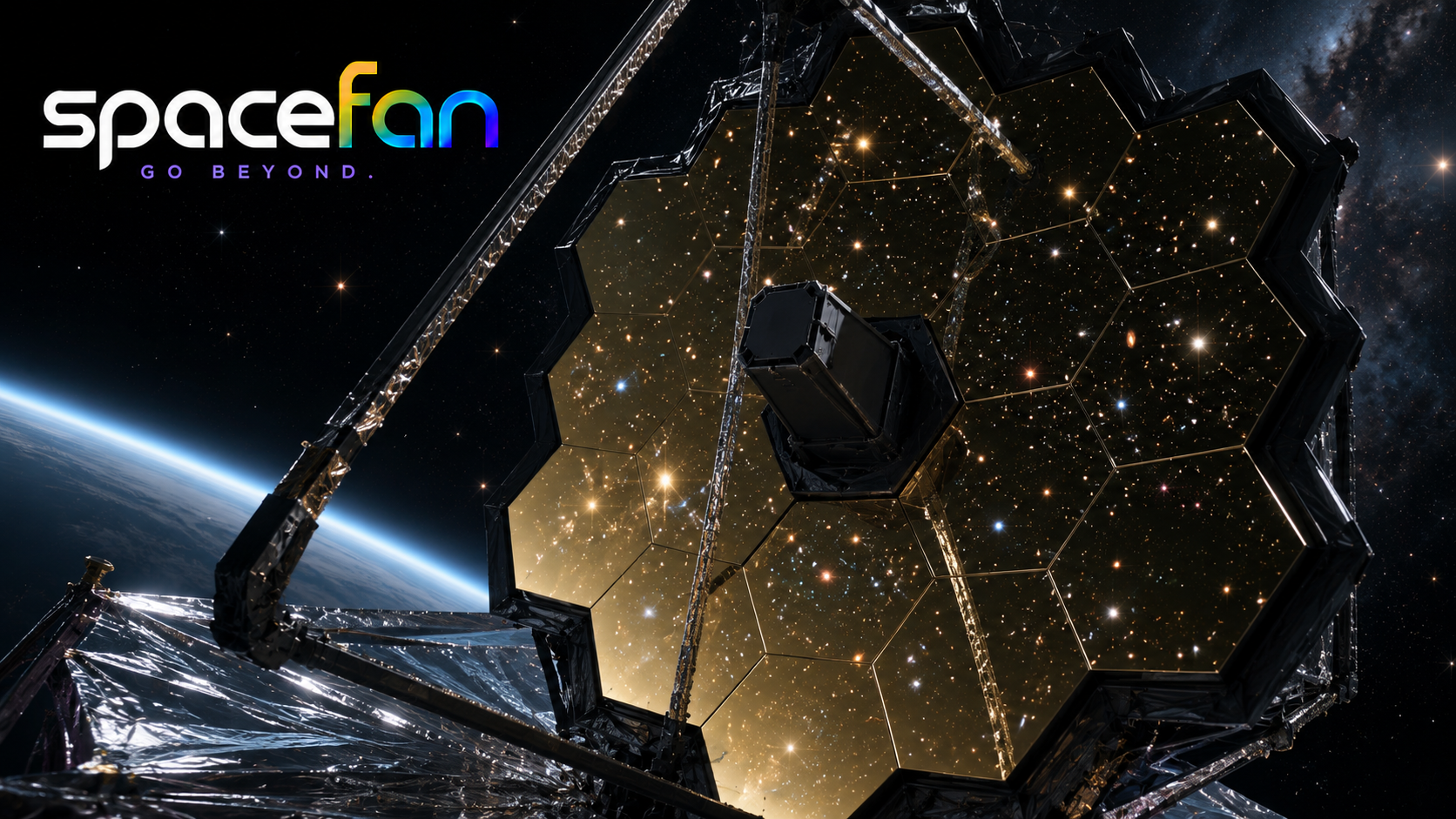
James Webb Space Telescope in space with its gold segmented mirror facing the stars.
Photo: Space.Fan

Imagine looking back in time to when the universe was just a toddler, barely 550 million years old, and discovering that the cosmos was already throwing a surprisingly crowded party. That is exactly what astronomers recently stumbled upon using the James Webb Space Telescope. While peering into a patch of sky known as MACS0416, researchers spotted ten galaxies huddled together in a tight-knit group, defying expectations about how early and organized the young universe should have been. This dense gathering is roughly six to eight times more packed than what scientists typically see in the early stages of cosmic history, acting like a bustling metropolis in a vast, empty wilderness.
To confirm this discovery, the team employed a method called SAPPHIRES, using the telescope’s NIRCam instrument to scan for faint light signatures. By utilizing a technique known as slitless spectroscopy, they were able to pinpoint the unique light fingerprints of these distant objects, proving they were all clustered together in the same neighborhood. Perhaps most intriguing is the discovery that one of these early galaxies hosts an active, growing black hole. This finding, detailed in the Astrophysical Journal, suggests that black holes were already rapidly evolving even as the universe was still in its infancy, busy stitching together its first stars and gas.
This revelation is a big deal because it challenges our current understanding of how gravity shaped the structure of the cosmos. Most computer models suggest the universe should have been more spread out at that point, yet this find shows that gravity was already busy building massive, web-like structures much faster than we realized. While researchers caution that they only looked at a small slice of the sky—meaning this could be a lucky observation of a rare spot—it opens a new door for future surveys. By refining their simulations to account for these early cities of galaxies, scientists are now better equipped to search for other crowded pockets hidden in the deep reaches of time.
Source: Space.Fan