
Space
A New Look at the Invisible Shield Protecting Our Solar System
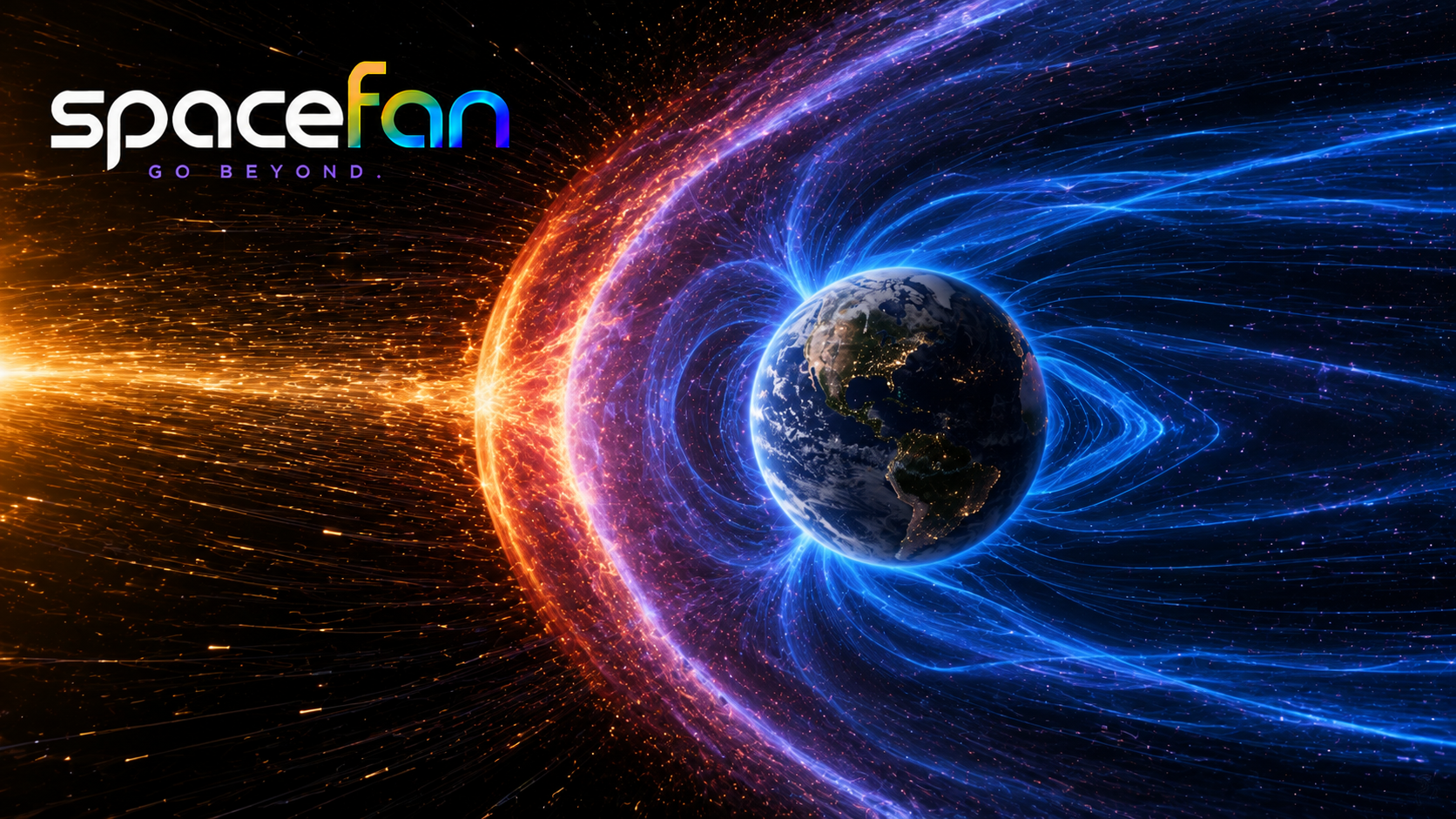
Earth surrounded by glowing magnetic field lines as solar particles strike the magnetosphere.
Photo: Space.Fan

Think of our solar system as a giant, protected bubble floating through a vast galactic ocean. At the center, our Sun acts like a constant engine, blowing a steady stream of charged particles known as the solar wind out toward the stars. But this wind doesn't just travel into a void; it eventually slams into the thin, wispy gas that sits between the stars. Mapping this distant, messy frontier has always been a challenge, but a team of researchers has now used a sophisticated computer program called MS-FLUKSS to visualize exactly how this boundary behaves, according to the study published in the Astrophysical Journal.
To get the most accurate picture, the team combined data from a legendary lineup of space explorers. They pulled information from the Ulysses probe, which studied the Sun from unique angles, alongside data from Voyager 2, currently trekking through the deep reaches of space, and the New Horizons mission, which famously zipped past Pluto. By feeding this real-world data into their model, researchers confirmed that the outer edge of our system is teeming with 'pickup ions.' These are essentially neutral gas atoms that get jolted into an electrically charged state after bumping into the solar wind, creating energy waves that heat up the surrounding space.
While this map provides a brilliant new look at our solar home, it is important to remember that it is a high-tech simulation rather than a photograph. Because the edge of our system is so impossibly far away, we cannot be everywhere at once to take measurements. However, this work is a major step forward, showing that even small flickers in the Sun’s activity can ripple across billions of miles to shape our protective bubble. By understanding these interactions, scientists hope to eventually predict how solar storms travel to the very limits of our neighborhood, giving us a clearer understanding of how our little corner of the galaxy interacts with the great unknown beyond.
Source: Space.Fan